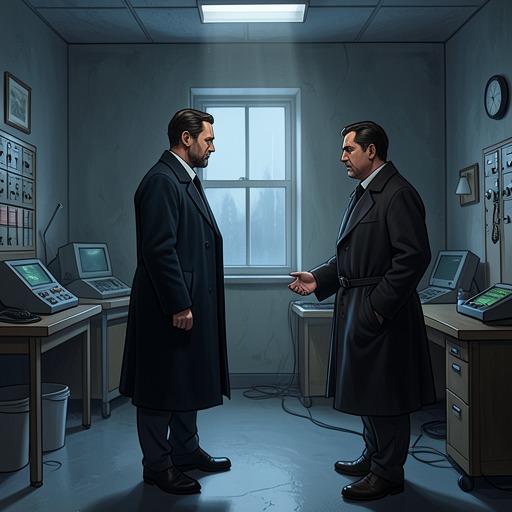
Fiedler
The Spy Who Came in from the ColdFiedler, head of counter-intelligence in the Abteilung, turns the investigation of Operation Rolling Stone into a contest over how intelligence should be interpreted: not simply what the evidence says, but what its patterns imply and whom they protect. His pursuit of a hidden collaborator brings him into direct opposition to Mundt, while the facts he assembles ultimately help expose how Leamas has been used within a larger operation.
Identity and Position
Fiedler holds the Abteilung’s counter-intelligence post during a struggle over power inside the organization. When Mundt reappears at headquarters after a period away, the reshaping of the service elevates Fiedler to head of counter-intelligence, while Mundt becomes deputy director of operations. Their positions place Fiedler in the role of scrutinizing possible penetration and Mundt among the senior figures whose authority he must examine.
The evidence establishes Fiedler through the work he does rather than through personal history. His authority is investigative: he questions Leamas, evaluates what the British agent has disclosed, and presents the case against Mundt before the Tribunal. He treats information as something whose value depends on context, not merely on whether individual details are accurate.
Investigating Leamas and Riemeck
During Leamas’s interrogation, Fiedler challenges the assumption that Karl Riemeck could have acquired the intelligence attributed to him unaided. When Peters asks whether all the intelligence came from Riemeck, Leamas answers that Riemeck had access to a great deal. Fiedler’s questioning, and Peters’s disbelief, make the issue of a high-level collaborator central to the inquiry. Leamas later recognizes that Control had raised the same question about Riemeck’s access. He begins to suspect that the shared concern points toward the person Control is especially anxious to protect, though at this stage he does not know the full explanation.
Fiedler also distinguishes between the information Leamas has already supplied and the intelligence needed to identify a source inside the service. The details of the Berlin organization may be accurate, he says, but they are not worth the promised payment of fifteen thousand pounds. What matters is Rolling Stone: the pattern that indicates a spy, even when the available information does not yet identify the person or the country in which that person is operating. Fiedler asks Leamas to consider how he himself would respond to such an incomplete indication. Leamas admits that an experienced officer would take it seriously, keep it in mind, and wait for further evidence rather than arresting an entire department. Their exchange shows that Fiedler is testing not only the facts Leamas supplies but also the reasoning by which those facts can be interpreted.
Evidence Against Mundt
A financial trail gives Fiedler a way to connect Leamas’s actions to Mundt. Fiedler reports that a Copenhagen bank confirmed that the co-signatory to Leamas’s account withdrew the money exactly one week after it was deposited. The withdrawal coincided with Mundt’s visit to Denmark under an alias to meet an American agent attending a world scientists’ conference. In the later Tribunal proceedings, Fiedler sets out the details more formally: Leamas opened the account in the name Robert Lang, deposited ten thousand dollars at the Royal Scandinavian Bank on June 15, and the co-signatory withdrew the sum a week later. Fiedler notes that Mundt was in Copenhagen on June 21, ostensibly on secret Abteilung business.
Fiedler adds a second apparent correspondence involving Helsinki. Leamas visited the city to deposit money around September 24, and Mundt made a clandestine journey to Finland on October 3, again allegedly for the Abteilung. The bank in Helsinki sent no reply, a gap Fiedler openly acknowledges rather than concealing. Set beside the Copenhagen record, however, the dates form part of his case: Leamas’s deposits and Mundt’s movements appear to align. The evidence is circumstantial, but Fiedler presents its chronology as a pattern demanding explanation.
The Tribunal and Its Reversal
At the Tribunal, Fiedler returns to the special security arrangements governing the circulation of the Rolling Stone file, the bank letters, and the reply received from Copenhagen. He recounts the evidence to the assembled body and directs attention to Mundt’s presence in the room. The procedure gives his investigation a public, organized form, but the Tribunal has no executive powers. After Leamas is declared under arrest, the presiding woman states that the people’s prosecutor, working with Mundt, may consider what action to take against him as a British agent and murderer.
Leamas looks past Fiedler toward Mundt, whose attention remains fixed on Fiedler. In that moment Leamas understands the scale of the deception. The recognition changes the meaning of the case that Fiedler has built: the evidence and interrogation have not simply been moving toward the exposure and removal of Mundt. Fiedler’s investigation has unfolded inside a scheme whose full design Leamas only now perceives. The evidence does not describe Fiedler’s subsequent fate, but it establishes the decisive reversal: the investigator’s apparent advance against Mundt is overtaken by the concealed operation of which Leamas has been made a part.
Narrative Role
Fiedler gives the novel’s intelligence plot its most explicit exercise in inference. He does not treat a spy’s existence as self-proving; he moves from an unexplained volume of material, through doubts about Riemeck’s independent access, to dates and financial records that appear to connect Leamas’s deposits with Mundt’s journeys. Each clue has limits: the Helsinki bank does not reply, and a sequence of coincidences is not by itself a complete account. Yet Fiedler’s willingness to assemble those fragments makes him a serious threat to Mundt and draws Leamas into the investigation’s logic.
That logic is also the source of the character’s dramatic vulnerability. Fiedler’s case appears persuasive because its separate details reinforce one another, but the ending forces the reader to reconsider what the case has been made to accomplish. His role therefore joins analytical competence to the novel’s larger uncertainty about intelligence work: evidence can expose a hidden relationship, but the people who collect and interpret it may themselves be moving within a deception they cannot fully see.